|
|
![[NJIT Library Logo]](https://libapps.s3.amazonaws.com/customers/2307/images/Libcal-logo.jpg)
|
|
|
|
|
|
|
|
The models for academic publishing have changed dramatically over the last few decades. When the print model moved to the online environment and large publishers took over small society journals, academic research became increasingly more expensive to access. New models have emerged in response to this changing publishing landscape.
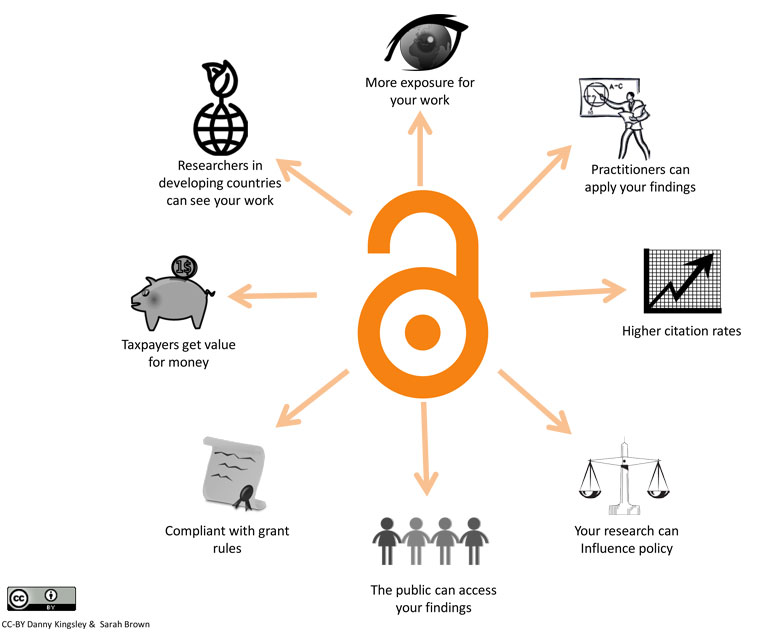
Open Access (OA) publishing is relatively new, having just emerged within the last few decades. OA is different from traditional scholarly publishing models as the content is free for readers to access. There are many benefits to Open Access publishing by providing immediate and free access to academic scholarship. For example, free unrestricted access means all can benefit from the research, compared to those who work at an institution that pays for access or can afford it themselves. In addition, the increase in visibility can increase the citations and impact of the work.
This page's content is from Navigating the Research Lifecycle for the Modern Researcher by Brianna Buljung, Emily Bongiovanni and Ye Li is licensed under a CC-BY-NC.
|
Self-Publication |
Grey Literature |
Scholarly Publishing |
|
|
|
Reader access to journal content depends on the journal’s distribution model. The broad types of journals are traditional, Open Access, and hybrid. There are peer-reviewed journals in each of these models, however the access and distribution of these journals differ.
Traditionally, authors will transfer the rights to their works to the publisher and the publisher will charge readers to access the content. These journals use a subscription model for universities and institutions to pay for access to the journal’s content. In this subscription model, large publishers will offer bundles of journals at different costs to the university. These subscription costs are extremely expensive and many libraries struggle to maintain paying these subscriptions. Open Access publishing has emerged as a solution to these extreme costs.
|
Traditional |
Open Access |
Hybrid |
|
|
|
Source: Cornell University, Carnegie Mellon University, Pratt Institute
|
